
Giovanni Battista Caproni was one of the pioneers of early aviation and a key figure in the development of multi-engine aircraft. Best known for his innovative bomber designs and the ambitious Caproni Ca.60 flying boat project, Caproni helped shape the future of military and passenger aviation during the early 20th century. His visionary ideas continue to hold an important place in aviation history.
Who Is Giovanni Battista Caproni?
Giovanni Battista Caproni was an Italian aeronautical engineer, civil engineer, electrical engineer, and pioneering aircraft designer best known as the founder of the Caproni aircraft company. Born on July 3, 1886, in Massone d’Arco, Trentino — then part of the Austro-Hungarian Empire and later incorporated into Italy after World War I — Caproni became one of the most influential figures in early aviation history.
Driven by a vision of expanding the possibilities of flight, Caproni played a major role in the development of multi-engine aircraft and strategic bombers during World War I. His innovative ideas later led to ambitious experimental projects such as the Caproni Ca.60, a massive flying boat designed for transatlantic passenger travel. Through his groundbreaking work, Caproni helped shape the evolution of both military and civil aviation.
His Life and Career
In 1906, he obtained the doctorate in electrical engineering from the Montefiore Institute in Liège. Then, in 1907, a degree in civil engineering at the Polytechnic of Munich.
In 1909, Giovanni Battista Caproni returned to Italy after having taken courses in civil engineering in Munich, electricity in Liège and aeronautical construction in Paris. His birthplace, Massone d’Arco being then under Austro-Hungarian domination, he settled in Taliedo, a district in the south-eastern area of Milan, near the current Milan-Linate airport. It was in Taliedo that he made his first plane, a biplane which made its first flight on May 27, 1910 and that he founded the Società de Agostini e Caproni, which later became Società Caproni e Comitti.
Why Caproni Was Historically Important
Although many of Caproni’s experimental concepts never became commercially successful, his work helped shape the future of multi-engine aircraft design. During World War I, Caproni bombers demonstrated the military potential of large heavy aircraft, while projects such as the Caproni Ca.60 reflected an early vision of mass long-range passenger aviation decades before modern airliners became practical. His designs contributed to the evolution of strategic bombing concepts, large aircraft structures, and long-distance air transport thinking
About the Company Caproni
At the beginning of the First World War, the Italian army had a squadron equipped with Ca.18. The Caproni Ca.18, was a single-engine, two-seat, monoplane reconnaissance and observation aircraft developed by the company Caproni in the 1910s.
During the 1930s, the Caproni company became an important industrial group, by diversifying its activities and developing abroad but also by buying a certain number of companies which most often kept their autonomy.
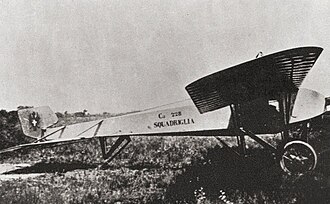
Caproni Ca.18
At the end of the Second World War, the Caproni group faced many difficulties. Giovanni Battista Caproni, accused of complicity with the fascist regime and collaboration with the German occupier, is being prosecuted. The factories have been devastated by the bombings and because of these unfortunate events there is no longer a market for the Italian aeronautical industry. In 1946 these charges were dropped.
To relaunch his business Caproni then decided to convert his factory in Arco to the production of motorcycles. Under the terms of a short-lived agreement with Ducati the frames of the Ducati Cucciolo are produced by Aero Caproni S.p.a, founded in 1950, which adapts a 49cc engine to them and the Capriolo brand is registered for the marketing of Caproni motorcycles. (Ducati Motor Holding is an Italian motorcycle manufacturer based in Bologna, Emilia-Romagna. And the Ducati Cucciolo is a 4-stroke auxiliary motor for bicycles designed during World War II by the Turinese lawyer, Aldo Farinelli and developed with the self-taught engineer, Aldo Leoni.)
In Rome on Octaber 27, 1957 Giovanni Battista Caproni died. This event had many repercussions for the group of the same name. Already in the early 1960s, the two-wheeler market was in decline in Italy. For these reasons, the grouping of producers has become very difficult.
Recommended article: Roland Garros – First Flight across the Mediterranean
Giovanni in Cinema
We see Giovanni, a well-known and very important engineer, as a side character in The Wind Rises, a much-loved Miyazaki animation. The main character of the movie is Jiro. Giovanni is Jiro’s hero and inspiration to become an engineer. We see him in all Jiro’s dreams.
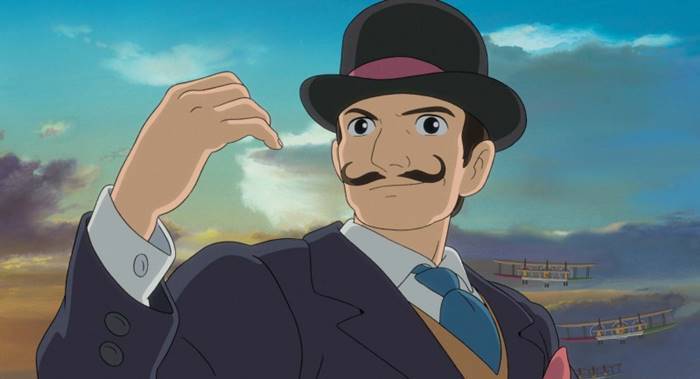
source: barbadillo.it
Resources
- Anon. (n.d.), Giovanni Battista Caproni, Wikipedia, Retrieved July 27, 2022
< https://en.wikipedia.org/wiki/Giovanni_Battista_Caproni > - https://stringfixer.com/tr/Gianni_Caproni, Retrieved July 30,2022
- <https://stringfixer.com/tr/Gianni_Caproni>