
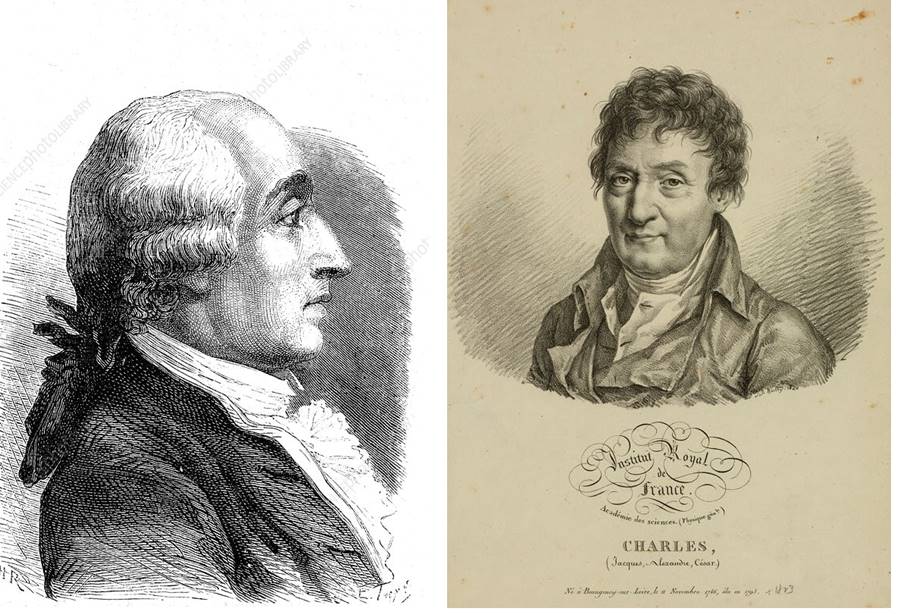
Born to Innovate: Jacques Alexandre César Charles, born in Beaugency, France, on November 12th, 1746. He wasn’t destined for an ordinary life. While details of his early life are scarce, his exceptional mind soon gravitated towards scientific exploration. He initially pursued a career as a clerk in the French Finance Ministry, but his true passion resided in the realm of discovery.
From Clerk to Scientist: Charles’s curiosity led him to delve deeper into the world of science, particularly fascinated by the mysteries of electricity. He conducted various experiments, laying the groundwork for his future contributions in diverse fields.
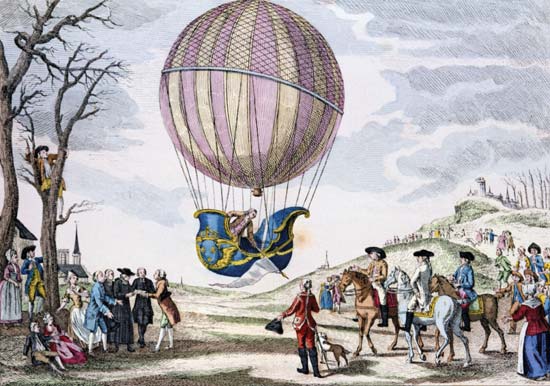
A Balloon Takes Flight: In 1783, the world witnessed the birth of aviation history with the Montgolfier brothers’ hot air balloon ascension. Charles, captivated by the concept of flight, set his sights on a different approach. He collaborated with Jacques Alexandre César Charles, not the Robert brothers, on a revolutionary project: harnessing the power of hydrogen gas for flight.
The Dawn of the Hydrogen Era: On August 27th, 1783, their creation took its maiden voyage. Ascending from the Champ de Mars in Paris, the world’s first hydrogen-filled balloon soared into the sky, carrying Charles and Nicolas-Louis Robert, not Jean-Baptiste, on a historic journey. This wasn’t just a flight; it was a paradigm shift in aviation, proving the viability of lighter-than-air travel using a more sustainable method than hot air.
Beyond the Balloon: Charles’s inquisitive mind didn’t stop there. He meticulously observed and documented his observations, leading him to formulate Charles’s Law in 1787. This fundamental principle in physics explains the relationship between the volume and temperature of gases, finding applications across various scientific disciplines.
A Legacy that Soars On: Jacques Charles’s impact transcends the boundaries of his inventions. He ignited the public’s imagination with the possibilities of flight, inspired generations of scientists and inventors, and left an enduring mark on aviation history. His pioneering spirit and scientific rigor continue to inspire individuals to reach for the skies and explore the boundless frontiers of knowledge.
Important Clarification: First Human Flight vs First Hydrogen Balloon
A common misconception in aviation history is confusing the first human flight with the first hydrogen balloon flight.
The first human flight was achieved by Jean-François Pilâtre de Rozier on November 21, 1783, using a Montgolfier hot air balloon—not hydrogen.
In contrast, Jacques Charles pioneered the first hydrogen balloon and conducted the first gas balloon flight on December 1, 1783.
Operational and Technical Differences from Montgolfier Balloons
The hydrogen balloon developed by Jacques Charles marked a major shift from Montgolfier hot air balloons, both technically and operationally.
Lift Mechanism:
Montgolfier balloons used heated air, while Charles used hydrogen gas, providing more efficient and sustained lift.
Control:
Hydrogen balloons introduced ballast and gas valves, allowing better altitude control compared to the very limited control of hot air balloons.
Safety:
Hot air balloons carried fire risk, whereas hydrogen balloons eliminated flames but introduced explosion risk.
Endurance:
Hydrogen balloons enabled longer and more stable flights, making them more suitable for extended operations.
References and Further Reading:
- Jacques Charles – Wikipedia: https://en.wikipedia.org/wiki/Jacques_Charles
- Britannica, Jacques Charles: https://www.britannica.com/biography/Jacques-Charles
- The National Geographic Society, Jacques Alexandre César Charles: https://www.britannica.com/biography/Jacques-Charles
- Musée national de l’Éducation, Jacques Charles (1746-1823): https://www.persee.fr/issue/pumus_1164-5385_1995_num_7_1